
How Event Modeling and Specification-Driven Development Save Software Projects
Discover how Specification-Driven Development (SDD) and Event Modeling transform chaotic business requirements into validated, production-ready event-sourced code.
Key Takeaways
The Problem: Vague requirements across Slack and Jira lead to fragile, misunderstood systems.
The Solution: Event Modeling provides a visual, jargon-free blueprint linking business intent directly to code.
The Core Mechanics: Systems are mapped using Commands (intentions), Events (immutable facts), and Read Models (displays).
The Outcome: Engineering and business teams align on precise "Given-When-Then" specifications before writing a single line of code.
Why 'Just Build It' Can Fail: The Cost of Vague Requirements
Picture this: It’s Thursday afternoon. You’ve just been handed the mandate to build a new backend for "BurgerTech," a rapidly growing food order management system.
Your requirements? A scattered mess of Slack threads, a few vague Jira tickets with no acceptance criteria, and an email from the product manager asking to "make it scale." If you start coding right now, you are walking blindfolded into a minefield. You’rme guaranteeing a weekend ruined by endless refactoring and production bugs because the business requirements got lost in translation.
Every software system tells a story, but when that story is trapped in developer jargon and disorganized tickets, the system fails. We need a better way. Enter Specification-Driven Development (SDD) and Event Modeling.
What is Event Modeling? (And Why You Need It)
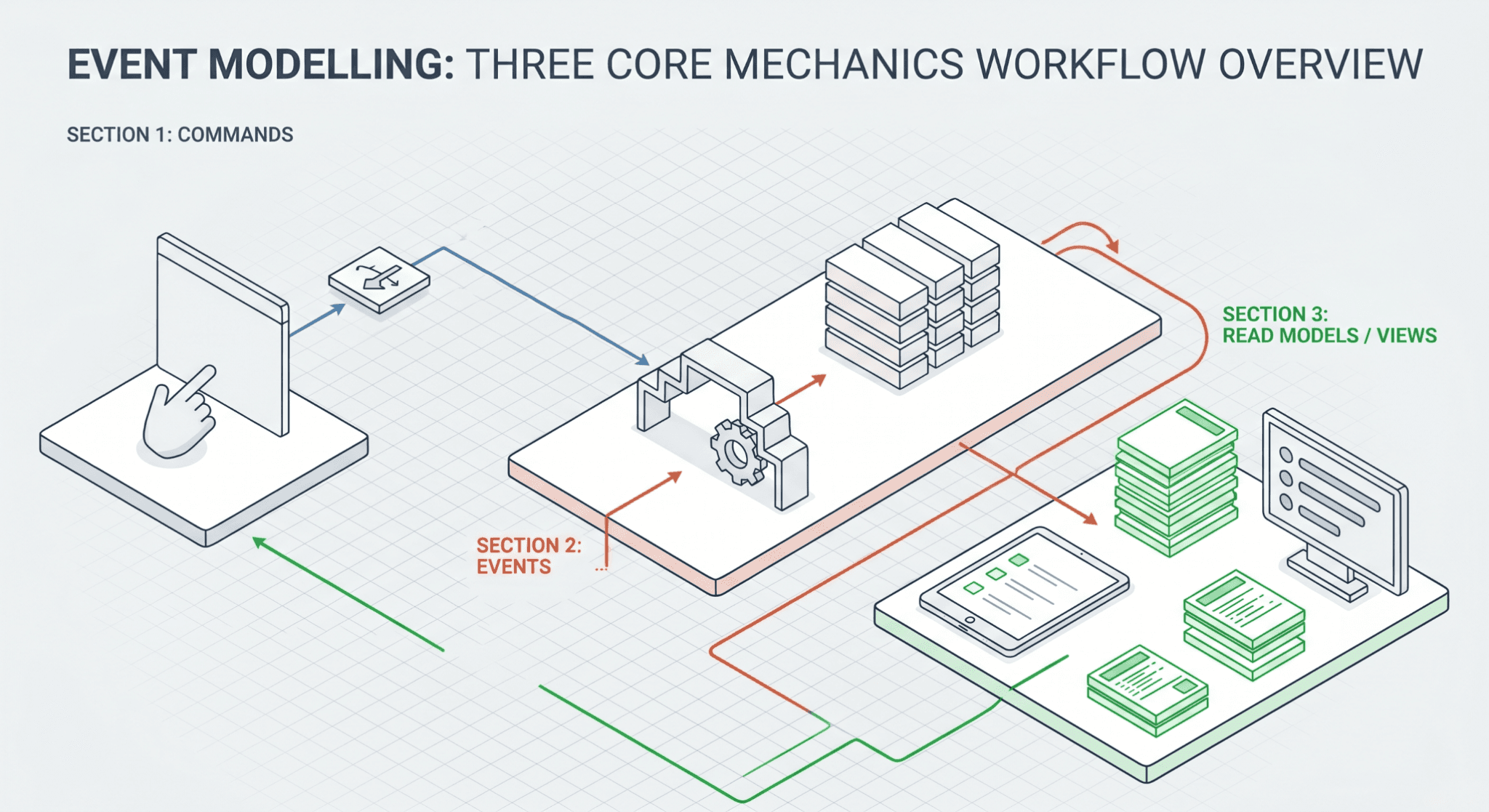
At its core, Event Modeling is a visual, jargon-free timeline that bridges the gap between business intent and validated code in event-driven systems. It maps out exactly what users do, what the system records, and what appears on the screen, reading left-to-right like a storybook.
Instead of writing dense technical architecture documents that put product managers to sleep, Event Modeling relies on a shared visual language built on three core mechanics.
Let's use our BurgerTech example to break these down:
Commands (The Intentions - Blue): These are actions a user wants to take. For example, Sarah clicks a button to execute the Place Order command for a vegan burger. Crucially, commands can either succeed or fail (maybe her credit card is declined).
Events (The Facts - Orange): These are immutable records of what actually happened. If Sarah's command succeeds, an Order Placed event is triggered. You cannot “un-happen” an event; it is a historical, indisputable fact in your system. Together, these events form the event store, the single source of truth your system is rebuilt from.
Read Models (The Views - Green): This is the data the system pulls together to show back to the user a projection of the events. This is Sarah’s Order Summary Screen or the Kitchen Dashboard showing the chefs what to cook.
Building the Event Modeling Blueprint: Horizontal and Vertical Slices
When you start Event Modeling, you lay out a horizontal timeline. It tells you what happens across different swim lanes (e.g., Customer, Manager, Automation).
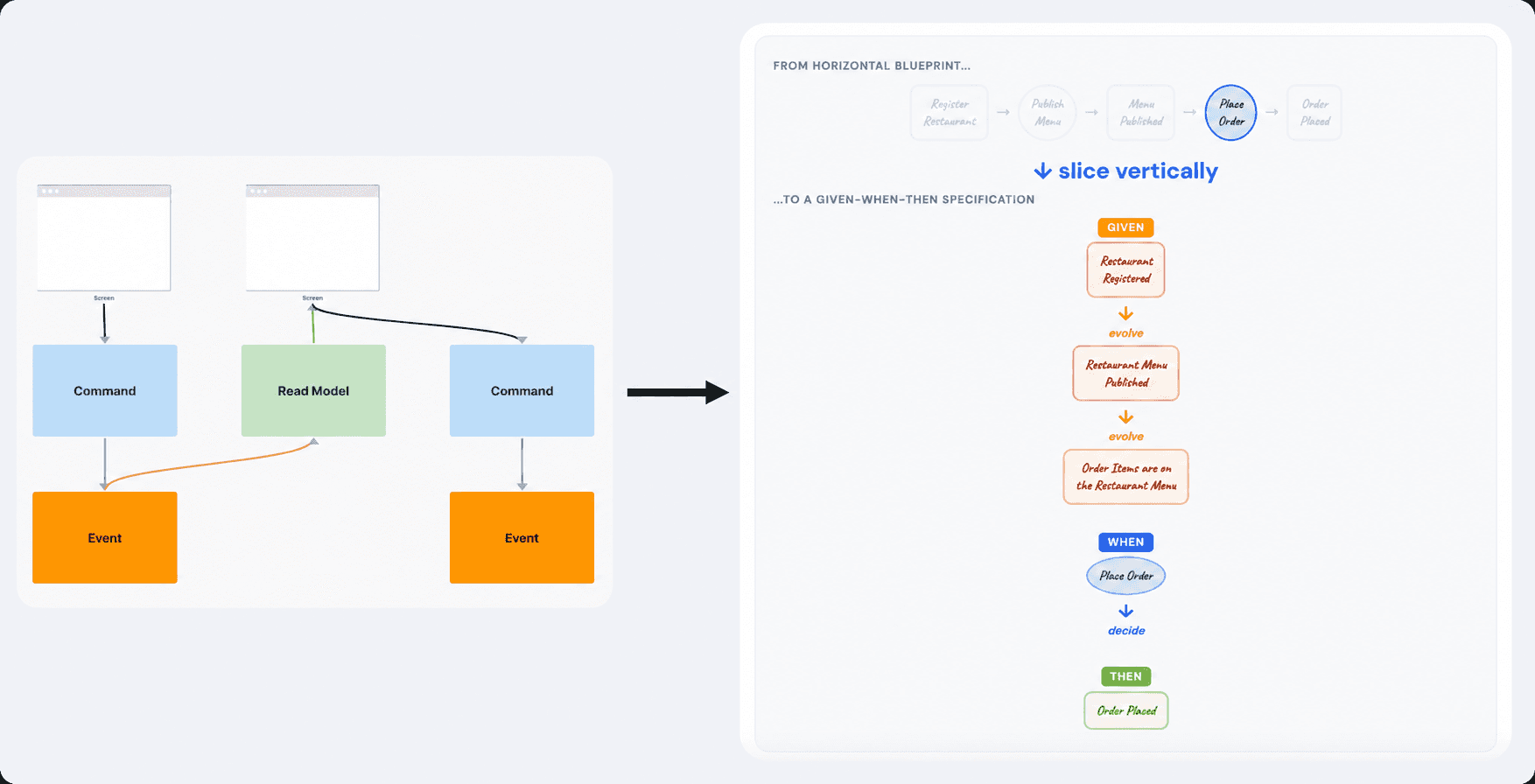
But horizontal knowledge isn't enough. In this phase, we slice the timeline vertically and pressure-test a single command. As an engineer, you must ask the acceptance-criteria questions that are usually skipped until it's too late:
What needs to be true for this "Place Order" command to succeed?
What are all the exact ways it can fail?
By answering these, you generate highly precise Given-When-Then specifications.
"Given the restaurant is accepting orders, When Sarah places an order, Then the Order Placed event is recorded."
You now have specifications precise enough to hand directly to an AI code generator or a fellow engineer, with absolutely zero follow-up questions needed.
Download the Infographic on Getting Started with Dev Agents >>
FAQ:
Q: What is Specification-Driven Development?
Specification-Driven Development (SDD) is an approach where you define precise, testable specifications for a system's behavior before writing any code. Instead of starting from vague tickets or Slack threads, you pin down exactly what must be true for an action to succeed and every way it can fail, then express that as Given-When-Then specifications (for example, "Given the restaurant is accepting orders, When Sarah places an order, Then the Order Placed event is recorded"). Because the specification is unambiguous, it can be handed directly to a fellow engineer or an AI code generator with no follow-up questions, keeping the code aligned with the original business intent.
Q: What is the main difference between a Command and an Event in Event Modeling?
A Command represents a user's intention or request to do something (which can be rejected), while an Event is an immutable, historical record of something that has already happened and cannot be changed.
Q: How does Event Modeling bridge the gap between business and engineering?
It uses a visual, jargon-free timeline of sticky notes (Commands, Events, Views) that both non-technical stakeholders and developers can easily understand, ensuring the code built matches the business intent exactly.
Q: How does Event Modeling relate to event sourcing and CQRS?
Event Modeling is the design practice; event sourcing and CQRS are the patterns it naturally maps to. Its three building blocks line up directly: Events are the immutable facts you persist (event sourcing), while Commands (the write side) and Read Models (the read side) are the separation that defines CQRS. An Event Model works as a blueprint whose Commands, Events, and Read Models translate straight into an event-sourced, CQRS-based implementation.
Want to learn more? You can check out the FREE Academy Course about Working with Development Agents - From Chaotic Requirements to validated code.
See it in production
Otto, Nets, MoneyLion, DPG Media and other teams run event-sourced systems in production with Axoniq.


" height="300px" id="PUlF9PxPI" transform="translate(146 0)" width="300px"/><path d="M 0 103.917 L 36.942 1.41 L 61.335 1.41 L 98.136 103.917 L 76.281 103.917 L 66.834 76.845 L 22.701 76.845 L 12.831 103.917 Z M 26.79 65.424 L 62.886 65.424 L 45.12 14.523 Z M 171.284 103.917 L 143.789 63.732 L 114.743 103.917 L 99.938 103.917 L 136.598 53.016 L 101.348 1.41 L 126.164 1.41 L 151.826 38.916 L 178.757 1.41 L 193.562 1.41 L 159.017 49.632 L 196.1 103.917 Z M 297.837 52.734 C 297.837 82.908 280.353 105.468 249.051 105.468 C 217.608 105.468 200.265 82.908 200.265 52.734 C 200.265 22.419 217.608 0 249.051 0 C 280.353 0 297.837 22.419 297.837 52.734 Z M 221.274 52.734 C 221.274 72.897 228.465 93.483 249.051 93.483 C 269.637 93.483 276.828 72.897 276.828 52.734 C 276.828 32.43 269.637 11.985 249.051 11.985 C 228.465 11.985 221.274 32.43 221.274 52.734 Z M 405.589 1.41 L 405.589 103.917 L 382.042 103.917 L 333.256 18.471 L 334.243 103.917 L 314.362 103.917 L 314.362 1.41 L 337.909 1.41 L 386.695 86.715 L 385.708 1.41 Z M 430.77 103.917 L 430.77 1.41 L 450.651 1.41 L 450.651 103.917 Z M 573.246 91.932 L 573.246 105.468 L 516 105.468 C 485.544 105.468 468.06 82.344 468.06 52.311 C 468.06 22.842 484.275 0 516.564 0 C 547.02 0 565.491 21.573 565.491 51.747 C 565.491 69.09 557.877 85.305 545.187 95.034 C 554.352 93.201 563.376 91.932 573.246 91.932 Z M 489.069 52.17 C 489.069 75.153 496.965 94.188 516.564 94.188 C 537.432 94.188 544.482 73.038 544.482 52.311 C 544.482 28.764 535.599 11.985 516.564 11.985 C 497.106 11.985 489.069 30.738 489.069 52.17 Z" fill="rgb(0, 0, 0)" height="105.46799999999996px" id="g7P19tPZB" transform="translate(8.294 399.083)" width="573.2455397949218px"/></svg>)