
The Hidden Cost of Homegrown Event Sourcing Infrastructure
DIY event infrastructure rarely fails at the beginning. In fact, the early success is what makes it dangerous.
The system works just well enough to justify the decision, while technical debt quietly accumulates in the form of missing guarantees, ad-hoc tooling, and operational workarounds. As the architecture grows, those small compromises compound into systemic complexity.By the time the true cost is visible, the organization is already committed to maintaining it and the cost of reversing course has multiplied.
This article exposes the hidden technical debt behind most homegrown event backends, and what organizations end up paying when the bill finally comes due.
The Real Cost of Building Event Infrastructure In-House
The engineering logic is sound: open source components are available, the team has the expertise, and full ownership means full control. Postgres handles persistence. Kafka moves events. A few custom services stitch the seams together. In the early stages, this architecture delivers.
That early delivery is the trap. The system is working, so the risks remain invisible, or at least ignorable. No one measures the hours spent debugging a Kafka offset alignment issue or the Friday night escalation when a Zookeeper node destabilizes and the on-call engineer is the only person who understands the topology. No one prices the institutional knowledge locked inside a single senior architect's head, knowledge that walks out the door the moment that engineer does. Which they may be more likely to do now that infrastructure nightmares are reoccurring frequently.
The costs are real. They are simply distributed in ways that make them easy to ignore until they become operational emergencies.
What DIY Event Infrastructure Actually Costs Engineering Teams
There is a name for what happens when organizations stitch together Postgres, Kafka, a message router, service discovery, and custom monitoring into a pseudo-platform: the Operational Stitching Tax.
It does not appear on a balance sheet. It appears in sprints.
Every Kafka version upgrade ripples through the stack. Every schema change in Postgres triggers a cascade of downstream adjustments. Every new service that joins the architecture inherits the accumulated complexity of every integration decision made before it. Junior engineers spend weeks, sometimes months, reaching basic productivity, not because the domain is complex, but because the infrastructure is.
Teams that have walked this path consistently report the same math: senior engineers spending 30–40% of their time on infrastructure maintenance instead of product development. For a team of ten engineers at market rate, that is $600,000 per year in opportunity cost —money spent maintaining plumbing. Are your competitors doing the same, or are they using engineer time to build differentiating products? What happens when your boss asks, “How much of what your engineers built last quarter was infrastructure and how much was the product your customers actually pay for?”
The Missing Guarantees in Homegrown Event-Driven Systems
The deepest cost of homegrown event infrastructure is not operational overhead. It is what the architecture was never designed to guarantee.
A general-purpose event backend, assembled from components built for adjacent problems, does not natively provide the guarantees that event-driven systems actually require at scale: strong ordering, exactly-once processing semantics, consistent snapshotting, reliable replay, and the complete causal history of every decision the system has ever made.
These guarantees can be approximated. Teams build workarounds. Workarounds become conventions. Conventions become tribal knowledge that only a handful of people fully understand. And when something breaks — or when a regulator asks why a specific decision was made six months ago — approximations are not enough.
One large U.S. bank discovered this in the form of audit preparation. Each compliance cycle required teams to manually reconstruct decision histories from fragmented logs across multiple systems. Days of engineering time. Thousands of hours of legal review. Not because the data was unavailable, but because the architecture had never been designed to answer that question.
When You Can't Explain AI Decisions to Regulators, the Architecture Is the Problem
For organizations that have spent years investing in AI, this gap is no longer abstract. It is a production blocker.
Regulators operating under the EU AI Act, SR 11-7, and a growing body of sector-specific frameworks are asking a question that homegrown event infrastructure structurally cannot answer: why did this system make this decision?
Logs record what happened. Monitoring records that something happened. Neither records the complete causal chain.
Retrofitting that capability onto a homegrown backend is not a configuration change. It is a redesign. Organizations that have attempted it report costs of $3M–$10M to build what purpose-built event sourcing delivers structurally at the foundation.
The teams whose AI projects are stuck in compliance review are not facing a compliance problem. They are facing an architecture problem that was created years earlier.
How Event Sourcing Infrastructure Technical Debt Compounds Over Time
Technical debt compounds over time; every new service added to a homegrown event backend inherits its constraints. Every team that onboards into the architecture inherits its complexity. Every business rule change that requires a data migration inherits its fragility. The architecture does not just fail to scale gracefully, it actively resists change, because the cost of change grows with the debt already accumulated.
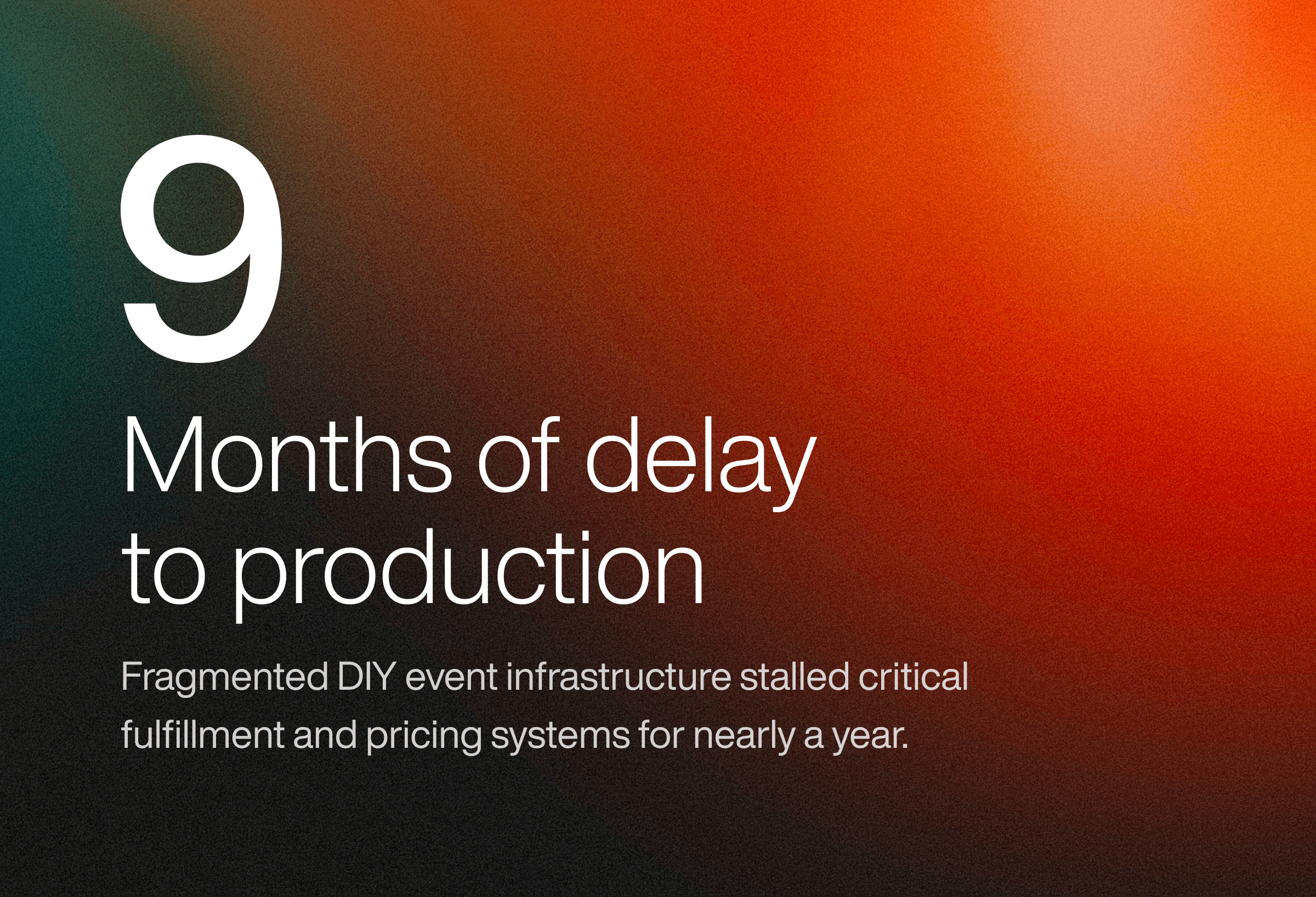
A large U.S. grocery and retail operation, experienced this compounding constraint recently. Their engineers were building exactly the kind of complex, distributed event-driven system that modern retail demands. The homegrown approach consumed nine months before they reached production.
The opportunity cost of that delay was not a line item. It was nine months of features competitors were shipping. Perhaps more importantly, regulatory pressure turned this into a crisis because the grocer could not meet FSMA regulations, which require end-to-end product traceability in retail supply chains. An audit revealed the grocer couldn't prove why shipments were accepted or rejected at receiving docks.
This pattern repeats across industries and while the may timeline vary, the outcomes do not.
When the Riskiest Path Is the One You're Already On
To be fair, the build decision had logic behind it. The team was knowledgeable, the components existed, and the architecture worked; at first. What was missing was a full accounting of what the architecture would need to become —and what it would cost to get there through a homegrown path rather than one designed for that destination.
The riskiest architectural decision is not always the one you're weighing, sometimes it is the one you made three years ago and are still paying for, every sprint.
Purpose-built Event Sourcing
Purpose-built event sourcing infrastructure is not a luxury for organizations building at scale in regulated or complex environments, it’s a necessity.
Axoniq's event-driven infrastructure was designed from first principles to provide what homegrown stacks must approximate: a purpose-built event store with strong ordering guarantees, complete causal history for every decision, built-in explainability for AI systems, and the operational visibility that allows entire teams to understand and debug complex distributed workflows.
The result is infrastructure that scales with the architecture instead of constraining it. Organizations that have replaced homegrown event sourcing backends with Axoniq consistently report the same positive outcomes: engineering teams redirected from infrastructure maintenance to product development, compliance cycles measured in hours rather than weeks, and AI initiatives that reach production because the architecture already answers the questions regulators are asking.
The Operational Stitching Tax does not disappear on its own. It accumulates until the cost of continuing exceeds the cost of changing course.
If your team is currently maintaining a homegrown event backend, it is worth asking how much of what they built last quarter was infrastructure and how much was the product you actually sell.
See how a major U.S. grocer moved off its homegrown event infrastructure: read the customer story.
See how a major U.S. grocer moved off its homegrown event infrastructure: read the customer story.
See it in production
Otto, Nets, MoneyLion, DPG Media and other teams run event-sourced systems in production with Axoniq.


" height="300px" id="PUlF9PxPI" transform="translate(146 0)" width="300px"/><path d="M 0 103.917 L 36.942 1.41 L 61.335 1.41 L 98.136 103.917 L 76.281 103.917 L 66.834 76.845 L 22.701 76.845 L 12.831 103.917 Z M 26.79 65.424 L 62.886 65.424 L 45.12 14.523 Z M 171.284 103.917 L 143.789 63.732 L 114.743 103.917 L 99.938 103.917 L 136.598 53.016 L 101.348 1.41 L 126.164 1.41 L 151.826 38.916 L 178.757 1.41 L 193.562 1.41 L 159.017 49.632 L 196.1 103.917 Z M 297.837 52.734 C 297.837 82.908 280.353 105.468 249.051 105.468 C 217.608 105.468 200.265 82.908 200.265 52.734 C 200.265 22.419 217.608 0 249.051 0 C 280.353 0 297.837 22.419 297.837 52.734 Z M 221.274 52.734 C 221.274 72.897 228.465 93.483 249.051 93.483 C 269.637 93.483 276.828 72.897 276.828 52.734 C 276.828 32.43 269.637 11.985 249.051 11.985 C 228.465 11.985 221.274 32.43 221.274 52.734 Z M 405.589 1.41 L 405.589 103.917 L 382.042 103.917 L 333.256 18.471 L 334.243 103.917 L 314.362 103.917 L 314.362 1.41 L 337.909 1.41 L 386.695 86.715 L 385.708 1.41 Z M 430.77 103.917 L 430.77 1.41 L 450.651 1.41 L 450.651 103.917 Z M 573.246 91.932 L 573.246 105.468 L 516 105.468 C 485.544 105.468 468.06 82.344 468.06 52.311 C 468.06 22.842 484.275 0 516.564 0 C 547.02 0 565.491 21.573 565.491 51.747 C 565.491 69.09 557.877 85.305 545.187 95.034 C 554.352 93.201 563.376 91.932 573.246 91.932 Z M 489.069 52.17 C 489.069 75.153 496.965 94.188 516.564 94.188 C 537.432 94.188 544.482 73.038 544.482 52.311 C 544.482 28.764 535.599 11.985 516.564 11.985 C 497.106 11.985 489.069 30.738 489.069 52.17 Z" fill="rgb(0, 0, 0)" height="105.46799999999996px" id="g7P19tPZB" transform="translate(8.294 399.083)" width="573.2455397949218px"/></svg>)