

What is the conference about?
Agentic AI is moving from demos to production.
Teams everywhere are being asked to ship AI that doesn't just generate text, but acts: triggering processes, making decisions, touching real systems with real consequences.
01 — BUILD
How do you build?
Agentic systems need architecture that can support them. This conference is built around what that architecture looks like in practice.
02 — EXPLAIN
How do you explain?
What an autonomous system did, and why. Every decision, every state change, every action should leave a trail.
This is where event-driven architecture earns its place.
Systems built on events don't just process what happens — they remember it. That's not a nice-to-have when AI enters the stack; it's the foundation for auditability, explainability, and the confidence to hand real work to autonomous agents.
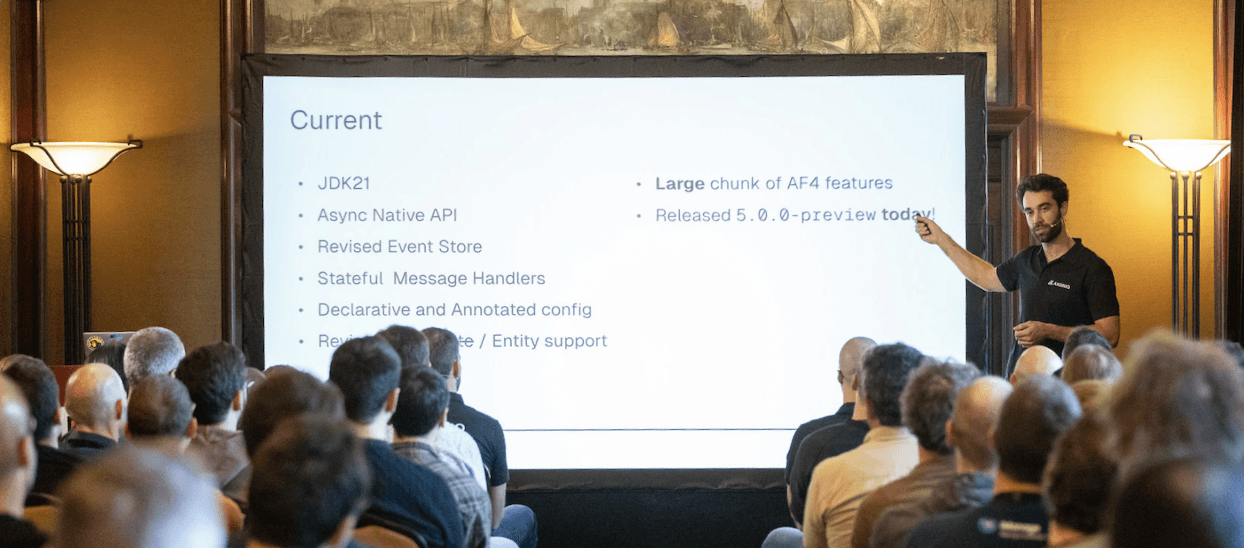
Two parallel tracks: From event sourcing lessons learned in production, to evolving models across versions and paradigms, to the AI applications teams are actually shipping on event-sourced systems.
Headline keynotes: voices outside the Axoniq ecosystem, bringing perspective from the wider world of AI and distributed systems.
Honest conversations: the wins, the mistakes, and what practitioners would warn you about. Not just the polished success stories.
A community that speaks your language: engineers, architects, and technical leaders building event-driven systems with Axon Framework, Axon Server, and well beyond.
Who is it for
No Axon experience expected 🥳
Software engineers, architects, and engineering leaders working on or moving toward event-driven systems. The programme spans event sourcing, CQRS, DDD, durable architecture, and AI on event-driven systems, whatever your stack looks like today.
About the unconference · Day 2
Beyond the Workflow: the future of event-sourced applications.
The day after the conference, we tear up the agenda. No fixed sessions, no slides, no stage. Just the people shaping the next generation of event-sourced applications, working through the questions that don't have clean answers yet.

WHAT IS AN UNCONFERENCE?
The hallway track, all day long
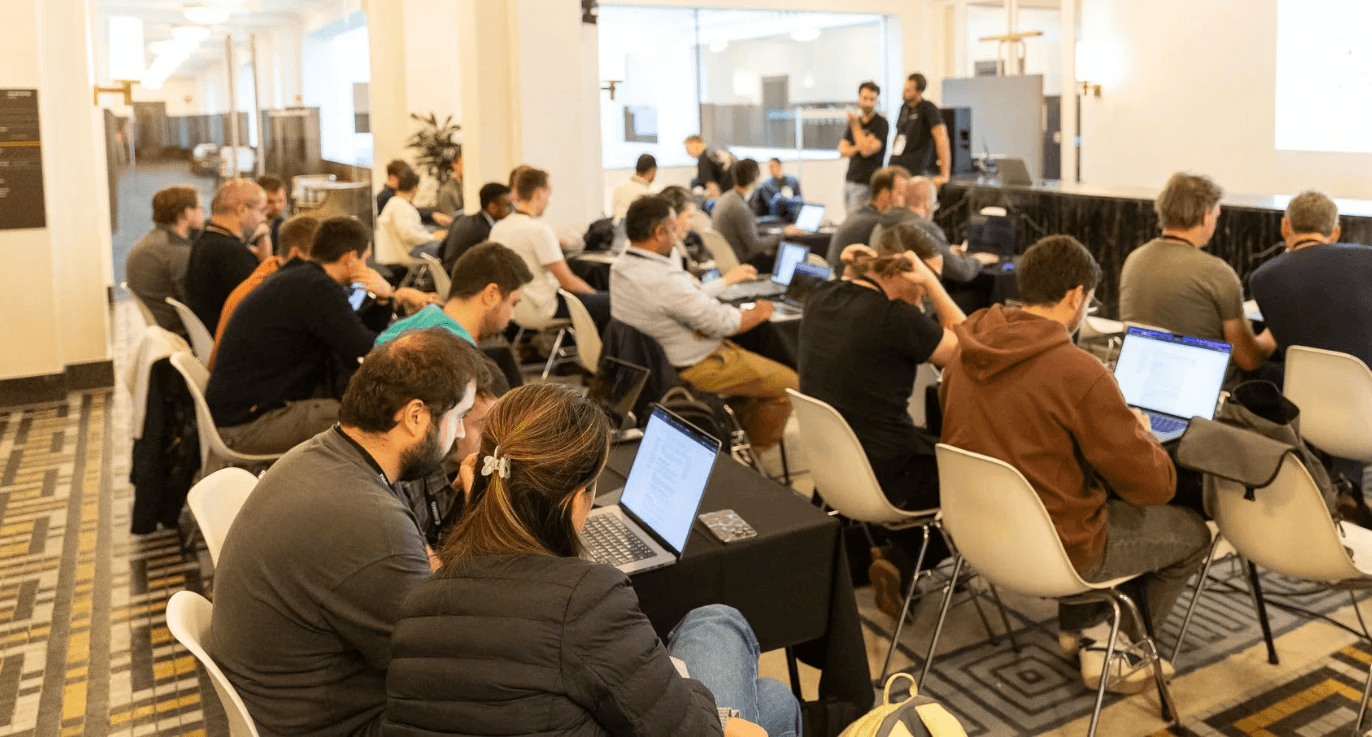
The best conversations at any conference happen in the hallways — so we built a whole day around them. An unconference is a participant-driven event: instead of organizers setting the programme, the attendees create it together on the day. Nobody is in the audience, because there is no audience. Everyone is a participant, every voice gets a seat, and the best sessions are the ones nobody planned.

How it works
It starts with the Marketplace.
The morning opens with a call for session proposals. Anyone can pitch a topic — a challenge you're wrestling with, an idea you want to pressure-test, or something you simply want to learn from the experts in the room. Proposals go up on the board, the group shapes the agenda together, and the day takes form.
Then, the sessions.
Topics run as parallel discussions across three spaces, in rounds throughout the day. Whoever proposed a topic facilitates the conversation — but these are discussions, not presentations. Come to contribute your experience, ask hard questions, and disagree constructively.
You choose your own path.
Pick the sessions that match your interests, and switch whenever you want. The unconference runs on the Law of Two Feet: if you find yourself neither learning nor contributing, walk to a conversation where you will be. Nobody takes it personally — it's the whole point.
How to do it right
The Four principles on Unconference
01
Whoever shows up are the right people.
Three deeply engaged participants beat thirty passive ones.
02
Whatever happens is the only thing that could have happened.
Sessions go where the participants take them, sometimes somewhere better than planned.
03
Whenever it starts is the right time.
Good conversations don't run on the clock.
04
When it's over, it's over.
And when it isn't, take it to the hallway and keep going.
WHO SHOULD COME?
Anyone genuinely curious about where event-sourced systems are heading.
No Axoniq experience required, no talk to prepare, no slides to make. If you've ever left a conference thinking the best part was the conversation over coffee — this day is that conversation, all day long.
Agenda
Tracks are separated by level, beginner and advanced, and by content: technical and business. Full programme and session details announced soon.
Day 1 · Conference
WED, OCTOBER 28
🚨 Exact schedule will be released soon
08:30
Registration & coffee
09:30
Opening keynote
A headline voice from outside the Axoniq ecosystem.
10:45
Parallel sessions · Round 1
Two tracks of deep technical sessions and real-world case studies.
12:30
Lunch 😋
13:30
Parallel sessions · Rounds 2 & 3
Event sourcing lessons from production, evolving models across versions and paradigms, AI on event-sourced systems.
16:45
Closing keynote
When it's over, it's over. And when it isn't — take it to the hallway.
17:30
Community drinks
The hallway conversations that change how you think about your stack.
Day 2 · unConference
THU, OCTOBER 29
09:00
Doors open & coffee
09:30
The Marketplace
Pitch your topic, shape the agenda together, and the day takes form.
10:30
Session rounds
Parallel discussions across three spaces, in rounds throughout the day. The Law of Two Feet applies.
12:30
Lunch 😋
13:30
Session rounds continue
Working through the questions that don't have clean answers yet.
16:30
Closing circle
When it's over, it's over. And when it isn't — take it to the hallway.
Ticket
Two days. One ticket.
Three chances to save.
Every ticket covers the complete programme on both days — conference and unconference. The earlier you book, the less you pay.
Blind Bird
For the ones who don't need to see the line-up to know they're coming.
$99
On sale from July 9 -> Aug 6
Early Bird
For the planners. Same full access, still ahead of the crowd.
$199
On sale from Aug 7 -> Sep 28
Regular
Last call — right up to the day before the conference.
$299
On sale from Sept 29 -> Oct 27
Every ticket includes
In-person access to the complete programe on both days: conference and unconference
Meet fellow developers, architects, and technical leaders
Access to all live presentations, demos, and the keynotes
Lunch and refreshments included on both days
Coming as a team? Contact us about group tickets.
Practical info
Getting to Leeuwenbergh, and making the most of Utrecht 📍
The venue sits in the southern part of the Museumkwartier, just inside the city singel — at the end of Park Lepelenburg, a short walk from the historic centre.

" height="300px" id="PUlF9PxPI" transform="translate(146 0)" width="300px"/><path d="M 0 103.917 L 36.942 1.41 L 61.335 1.41 L 98.136 103.917 L 76.281 103.917 L 66.834 76.845 L 22.701 76.845 L 12.831 103.917 Z M 26.79 65.424 L 62.886 65.424 L 45.12 14.523 Z M 171.284 103.917 L 143.789 63.732 L 114.743 103.917 L 99.938 103.917 L 136.598 53.016 L 101.348 1.41 L 126.164 1.41 L 151.826 38.916 L 178.757 1.41 L 193.562 1.41 L 159.017 49.632 L 196.1 103.917 Z M 297.837 52.734 C 297.837 82.908 280.353 105.468 249.051 105.468 C 217.608 105.468 200.265 82.908 200.265 52.734 C 200.265 22.419 217.608 0 249.051 0 C 280.353 0 297.837 22.419 297.837 52.734 Z M 221.274 52.734 C 221.274 72.897 228.465 93.483 249.051 93.483 C 269.637 93.483 276.828 72.897 276.828 52.734 C 276.828 32.43 269.637 11.985 249.051 11.985 C 228.465 11.985 221.274 32.43 221.274 52.734 Z M 405.589 1.41 L 405.589 103.917 L 382.042 103.917 L 333.256 18.471 L 334.243 103.917 L 314.362 103.917 L 314.362 1.41 L 337.909 1.41 L 386.695 86.715 L 385.708 1.41 Z M 430.77 103.917 L 430.77 1.41 L 450.651 1.41 L 450.651 103.917 Z M 573.246 91.932 L 573.246 105.468 L 516 105.468 C 485.544 105.468 468.06 82.344 468.06 52.311 C 468.06 22.842 484.275 0 516.564 0 C 547.02 0 565.491 21.573 565.491 51.747 C 565.491 69.09 557.877 85.305 545.187 95.034 C 554.352 93.201 563.376 91.932 573.246 91.932 Z M 489.069 52.17 C 489.069 75.153 496.965 94.188 516.564 94.188 C 537.432 94.188 544.482 73.038 544.482 52.311 C 544.482 28.764 535.599 11.985 516.564 11.985 C 497.106 11.985 489.069 30.738 489.069 52.17 Z" fill="rgb(0, 0, 0)" height="105.46799999999996px" id="g7P19tPZB" transform="translate(8.294 399.083)" width="573.2455397949218px"/></svg>)